We have all we need for everyone to live well.
Showing posts with label cropland. Show all posts

Friday, June 28, 2013

First Planting of the Cider Apples

On April 27, our team of twelve planted the first 150 trees in our first cider apple orchard in the northwest field above the farmstead. Procured from a seller in New York, there are 10 individuals of 15 varieties, each dominantly expressing one of the three major components of Wessex style cider: acid, bitter, and sweet. In the Wessex style, ciders are made from each variety of apple and three or more of these blended to produce the commercial product. The varieties were selected not only for flavor but for flowering and harvest season, roughly a third each of early, middle, and late. This should help ensure against crop loss due to vagaries of weather, reduce labor requirements in a given period, and facilitate the production of "seasonal" ciders.

This was a remarkable day. The team quickly bonded, and self-organized into groups responsible for digging the holes, distributing supplies, placing the trees and replacing the soil, watering, and installing the stakes and protective geotextile mulch and translucent tree guards. The work groups cross-trained one another, and traded tasks to prevent burnout. We'd estimated the whole job would take ten to twelve hours but together we got it done in less than five. Yay team!

Here's a little video that Debbie made of Derith & Dave digging a hole with the big tractor and PTO-driven auger.


All of the photos that follow were made by Derith Vogt at D&G Photography in Anamosa, Iowa.

Here are some of the big tractor's hydraulic and mechanical controls. Grr.


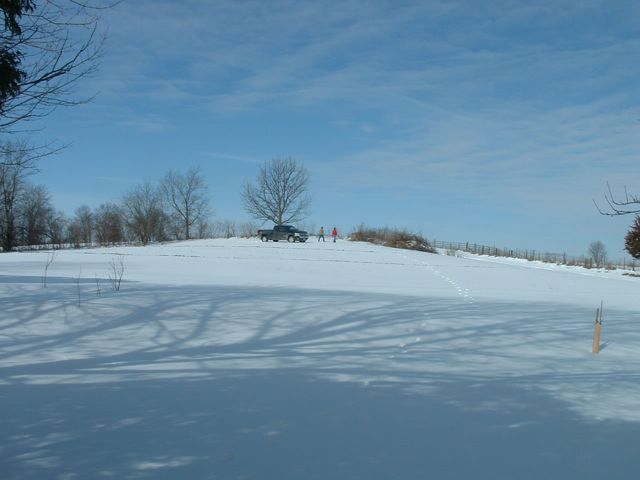
Here's the whole operation in one shot. We began at the top of the hill and worked our way down. In the bed of the truck were water barrels we filled from the pond with a sump pump. The little tractor pulled the utility trailer loaded with the bare-root trees and supplies.


Debbie prepares to water just-planted trees.


Derith & Gary strike an American Gothic pose.


After the trees were planted, difficult as it was to do, we pruned away all the side branches, and cut back the central leader to a height of three feet. Eventually the trees, which are on dwarfing rootstock, will be trained to trellises and kept to a maximum height of eight feet. Here, Jeff assists Alan while Mary looks on.


Gary does the initial half-fill of soil. Water was applied next to consolidate the soil and ensure good contact with the roots, then the rest of the soil, and more water.


Scot and Donna complete a planting.


Your faithful, if erratic, correspondent, ready to set a stake and secure the sleeve with zip ties. The fabric mulch is primarily to keep the base of the tree free of other vegetation that would compete for water, sunlight, and soil nutrients.


Team portrait at the end of the job.


From these trees we should be able to clone as many others as we like, by cultivating shoots from the rootstock, harvesting scion wood from the top growth, and grafting the two together. It's a long-term project.

Sunday, March 31, 2013

Fire Good

By small increments we prepare to put 150 cider apple trees in the northwest field at the end of April. Early on a calm Sunday morning three weeks ago we burned the large brush pile in the corner. This is what remained when I pulled all the metal and glass and every other damn thing from the burn-and-bury dump that had been there. And we'd added a lot of invasive mulberry and other matter that we'd cleared and trimmed elsewhere.


Cattle foraging on soybean stubble:


To the west and north of our northwest corner:


A diesel-soaked rag as a torch:


A few creatures, pheasant and rabbit and vole, abandoned homes in the brush pile, most before the fire but a couple rabbit not until the flames licked close.


These intriguing tracks, we finally concluded, represent the last steps of pheasant before their wingtips scrape the ground and they fly into the air:


It all went pretty quickly:


And that was that. But we've got a bunch of other brush piles...


Sunday, January 27, 2013

Farm Map Now Available for Viewing

Alan has combined GPS data with the latest aerial photograph of the farm to create a map of the property, a small image of which is reproduced below. You can always get to the full-size map by clicking the link at the top of the page. We'll add details as time goes by.


At present there is no legend, so here are some clues:

  • North is at the top
  • Solid pink is the lane from the road to the farmstead
  • Pink dotted lines are tractor trails and footpaths
  • Blue dotted lines denotes the creek and its tributaries
  • Yellow denotes the boundary fences
  • Circles are an incomplete inventory of the old growth trees
If you've any questions about what you're looking at, leave a comment below and we'll do our best to answer them.